Hiring an AI consultant for startups is different from hiring one for an established business. Your code and data may be the main thing your company owns, your cash is limited and investors will one day look closely at what you built. This guide covers the decisions that matter most for founders from pre-seed to Series A.
Key takeaways
- Decide first whether AI is part of your product or a way to run the company. The two need different partners and contracts.
- A fractional CTO for startups suits direction-setting and investor conversations; an agency suits defined building work.
- Make sure your company owns the code, prompts and models, and that accounts and keys are in your name from day one.
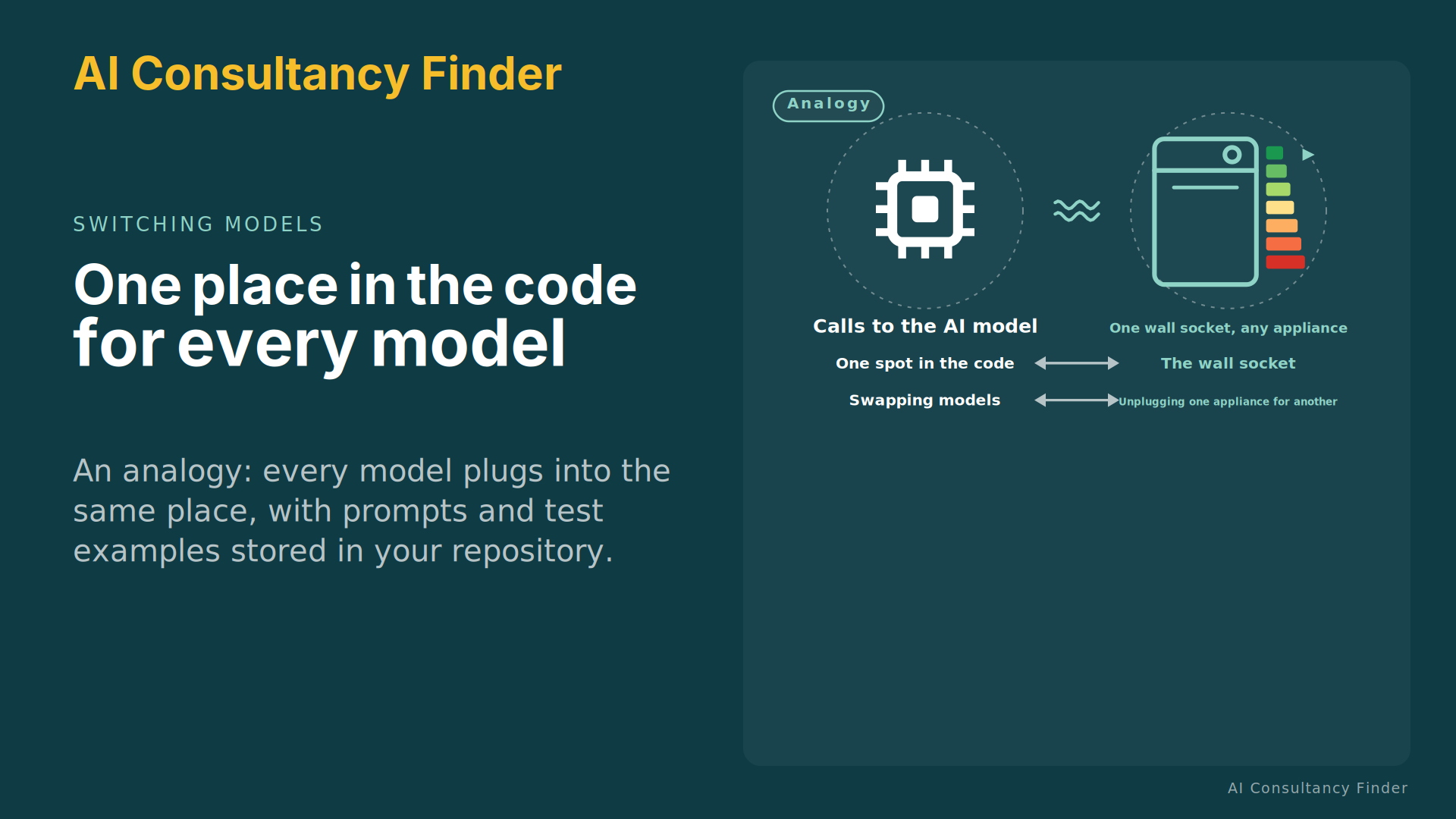
- Keep calls to the AI model in one place and keep a test set, so you can switch models.
- Grants exist but are competitive and change often. Check the official page before you plan around one.
Product work or operations work
AI in the product is part of what you sell, such as an assistant inside your app. It shapes your company's value, so ownership, documentation and security matter more than speed. AI in operations helps you run the business, such as sorting support emails. A short fixed-price project, or off-the-shelf tools, is often enough.
A quick test: if the partner disappeared tomorrow, would your product stop working? If yes, treat it as product work.
Speed against quality
A fast demo is often worth paying for, but fast builds tend to skip tests, documentation and careful handling of keys. Agree in writing whether you are buying a throwaway prototype, a first version you will keep or a production system. Most problems come from buying the first and ending up with the third.
Fractional leader or agency
A fractional CTO for startups, or a fractional chief AI officer, works part-time as a senior member of your team. They help you decide what to build, choose suppliers, hire engineers and answer investors' technical questions. An agency builds things, and suits work you can describe clearly when someone on your side can review it. Many startups use both: a leader who sets direction and checks the work, and a team who build. If you do, make sure the leader has no undeclared financial tie to the agency.
Our guides to fractional CTO, CIO or CAIO roles and the fractional chief AI officer go into more detail.
Own your code and avoid lock-in
Ask who will own the code, designs, prompts and any trained models, when ownership passes to you, and which of the partner's own tools your product will depend on. Put the answers in the contract and take advice from a qualified solicitor before you sign. Keep the code repository, hosting, domains and AI service accounts in your company's name.
AI models change often, so ask for calls to the model to sit in one place in the code, with prompts and a test set of examples stored in your repository. Then switching model becomes a task you can plan rather than a rebuild.
Getting ready for investors
Investors' technical checks vary widely, but in our experience they tend to touch on code ownership, documentation, security basics, dependence on one supplier or model, and the rights to the data you use. A few months before a round, ask an independent technical person to review your code as an investor might.
If a partner offers to take part of their fee in shares, take advice from a qualified accountant or solicitor first. Share schemes are covered by detailed tax rules, and we do not give guidance on them.
Grants and support
When we checked on 14 November 2026, UK Research and Innovation said Innovate UK Smart grants were closed to new applications.1 A BridgeAI competition for AI used in operational systems was open until 8 December 2026 at 11:00, for SME-led projects with a working MVP.2 Start Up Loans of £500 to £25,000 are available through the government-backed scheme.3 Deadlines may have passed by the time you read this. Our guide to AI grants and funding in the UK has more.
The full guidebook covers MVP scoping, contracts, investor due diligence and equity questions, with checklists you can print.
Sources
-
UK Research and Innovation, "Smart grants funding guidance", undated web page, https://www.ukri.org/councils/innovate-uk/guidance-for-applicants/guidance-for-specific-funds/smart-innovation-funding-guidance/, accessed 2026-11-14. ↩
-
Innovate UK Business Connect, "BridgeAI Deployment Catalyst: AI for Operational Systems", undated web page, https://iuk-business-connect.org.uk/opportunities/bridgeai-deployment-catalyst-ai-for-operational-systems/, accessed 2026-11-14. ↩
-
GOV.UK, "Apply for a Start Up Loan", undated web page, https://www.gov.uk/apply-start-up-loan, accessed 2026-11-14. ↩