If you are about to buy help with AI for the first time, you probably want one thing: a plan you can follow from "we think AI could help" to a project that works and that you still control afterwards. Our AI buyer's guidebook gives you that plan in one book, coming soon to Amazon in paperback, Kindle and audio.
Key takeaways
- One book covering every step, from naming the problem to looking after a live system.
- Written for UK businesses of any size, from sole traders to organisations with hundreds of staff.
- Neutral: it names no consultancy, agency or freelancer, and nobody paid to be in it.
- Includes checklists for the brief, the shortlist, the contract, security and after go-live.
What's inside
The guidebook follows the order in which buying actually happens. Each part stands on its own, so you can jump to the one you need.
- Start with the problem. Name one task, pick one measure and record today's figure, so you can tell later whether it worked.
- Check you are ready. Your information, your people, your process and an owner.
- Decide what kind of help you need. Advice, discovery, configuration, building, training or support, and how freelancers, consultancies, agencies and vendors differ. Our comparison of consultants, agencies and freelancers goes into more detail.
- Write a brief. What to include and why. It pairs with our guide to writing an AI project brief and the free template.
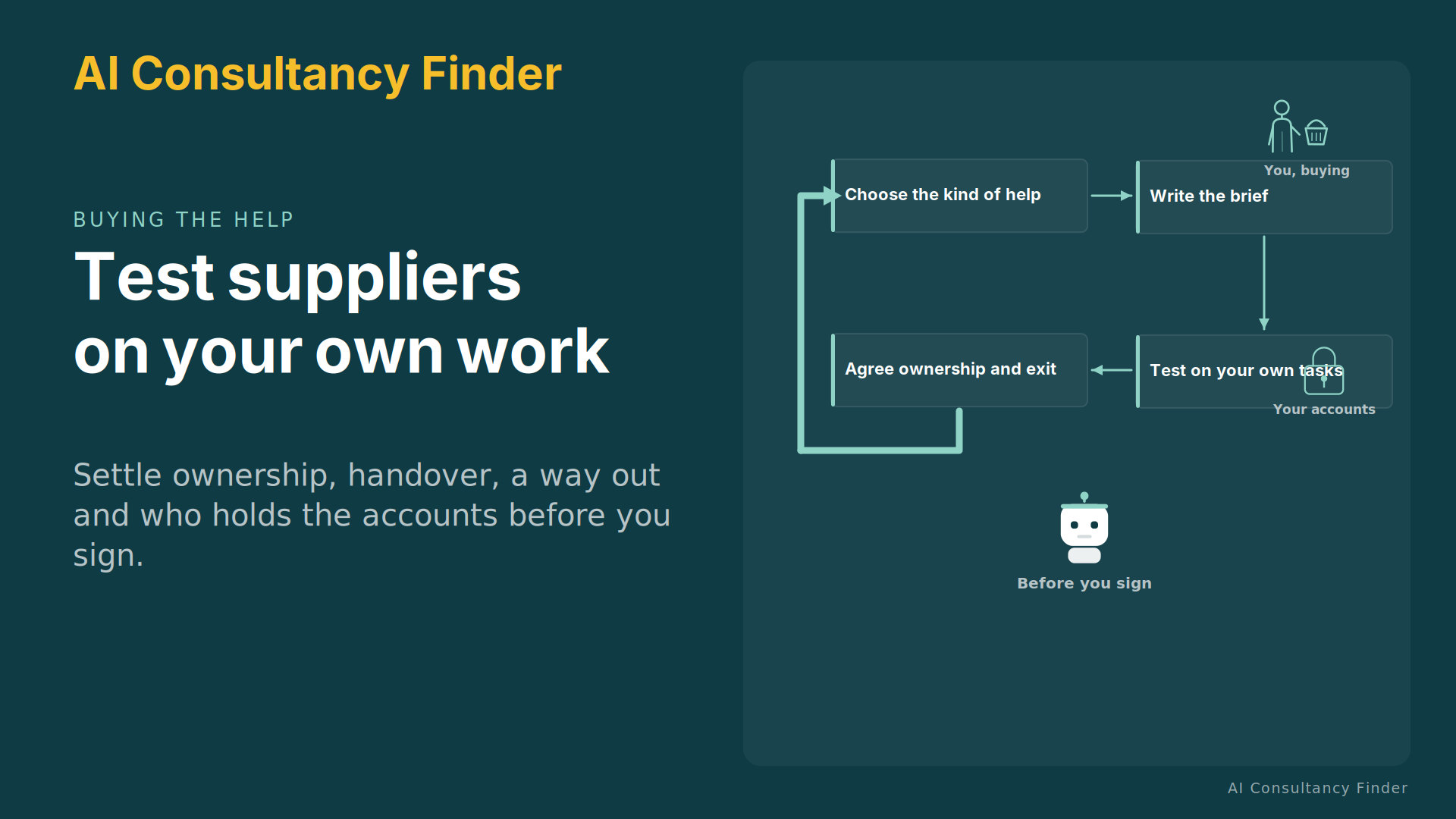
- Shortlist and evaluate on your own work. The questions to ask, how to compare proposals fairly and the warning signs.
- Contract for ownership, handover and exit. The points to settle before you sign, including who holds the accounts.
- Work well together. Discovery, pilots that can fail cleanly and bringing staff with you.
- Measure the results. Comparing like with like, and counting the time spent checking outputs.
- Ask the security questions. A plain-English list, with pointers to the National Cyber Security Centre's guidance. See also security questions for AI suppliers.
- Look after it once it is live. Keeping an owner, regular checks and watching for changes when AI models are updated.
Who it's for
It is for anyone in a UK business who has been asked to "look into AI" and needs to buy help to do it. The steps are the same at every size; the guidebook says where the advice differs.
- Micro businesses (0 to 9 staff): where the owner is the buyer, the user and the checker, and the first step needs to be small. See AI for micro businesses.
- Small businesses (10 to 49 staff): running a first proper pilot with a named owner. See AI for small businesses.
- Medium-sized businesses (50 to 249 staff): choosing between several possible projects. See AI for medium-sized businesses.
- Large organisations (250 or more staff): fitting the same principles into procurement and security review. See AI for large organisations.
What it is not
The guidebook is general guidance, dated 14 November 2026. It is not professional advice on law, tax or finance. Where your project involves personal information, staff or regulated work, it tells you to take advice from a qualified professional, and so do we.
Where to go next
If you want the short version first, start with how to choose an AI consultant and what an AI consultant costs. When you are ready to look for help, you can browse the directory.