Why write anything down before you have even spoken to a consultant? Because the brief is what lets you compare them. If you explain your problem differently on three calls, you get three proposals for three different projects, and no fair way to choose. One page, sent to everyone on your shortlist, fixes that.
This guide walks through our free template section by section: what each part is for, what a good answer looks like, and what to leave out.
Key takeaways
- Send the same brief to every consultant, agency or freelancer, and judge the replies only against it.
- Describe the problem in your own words, not the solution you think you need.
- Say how the task works today, so proposals have something to beat.
- Pick a budget band, not an exact figure.
- "We don't know yet" is a useful answer. Short is fine.
Why write a brief before the first call?
Three reasons.
It keeps the problem yours: If you let an adviser frame the problem, it can quietly be reshaped to fit what they already sell. Writing it down first means every proposal has to answer your question.
It makes replies comparable: Everyone gets the same facts, so differences in the proposals are real differences in approach, price and people.
It shows you where you stand: Writing down your data, your timeline and who decides often reveals gaps you would rather find now than halfway through a project.
What goes in each section?
1. The business
What you do, who your customers are, how many people work for you, and the tools you use day to day. Two or three sentences is enough. Listing your current software matters more than it looks: many tools you already pay for now include AI features, and a good consultant will check those first. See build, buy or bring in help.
2. The problem
The one problem you want solved, in your own words. Describe what happens today, who it affects and what it costs you in time or money. Say what you have already tried.
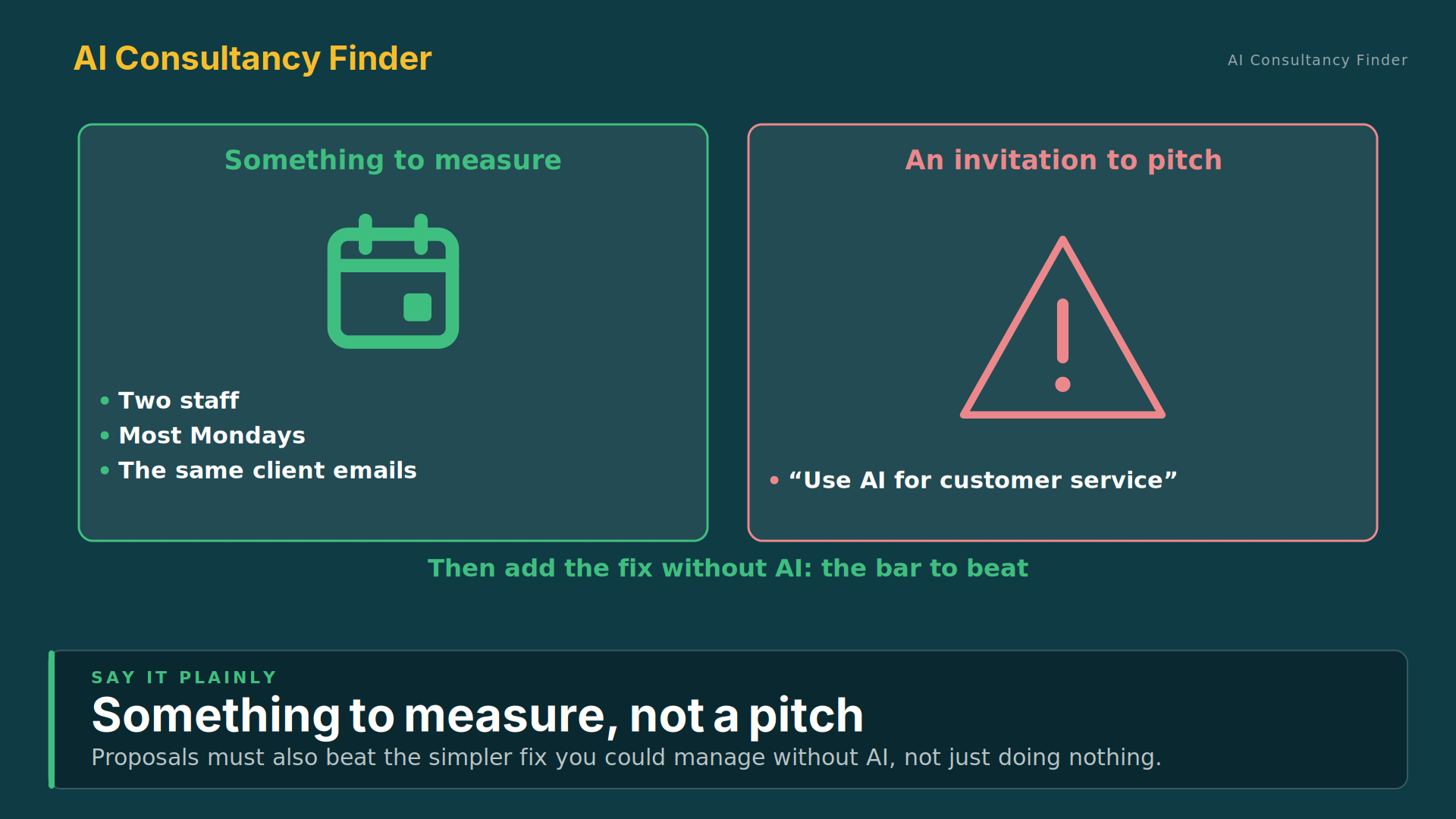
A good answer: "We answer the same handful of client questions by email every week. Two of us spend most of Monday on it, and replies can take two days." A weak answer: "We want to use AI for customer service." The first gives a consultant something to measure; the second invites a sales pitch.
Add one more line here: how would you solve this without AI? A better template, a shared inbox rule or a tidier spreadsheet might get you part of the way. Saying so means proposals have to show what they add over the simple option, not over doing nothing. If you are unsure the problem suits AI at all, read start with the problem, not the tool.
3. The outcome wanted
What will be different when this works? Write it so that you could tell, at the end, whether it worked: "answer routine customer emails within an hour", not "use AI for customer service".
Include where things stand today (the baseline), even roughly: how long the task takes, how often it goes wrong. Then add a date when you will review the result. Our guide to how your consultant will measure success covers this in more depth.
It also helps to say what level of error you can live with. AI tools will sometimes be wrong. A brief that admits this gets more honest proposals than one that expects perfection.
4. Data available
What information the work would use (emails, documents, spreadsheets, a customer database), roughly how much there is, where it is kept and who can give access to it.
Be honest about the state of it. If records are patchy or spread across three systems, say so. Consultants need to know, and it is a common reason projects take longer than planned. See getting your data ready for AI.
Say if any of it is sensitive, but do not send the data itself with the brief. Before you share customer or staff records with any consultant, check your obligations with a data protection adviser.
5. Budget band
Pick a band rather than an exact figure. The template offers under £2,500, £2,500 to £10,000, £10,000 to £25,000, over £25,000, or "not sure yet: please suggest options at different sizes".
A band lets consultants pitch at the right scale without anchoring every quote to one number. If you do not know the market, our guide to what an AI consultant costs gives dated UK day rates and what small businesses spend on AI in a year. "Not sure yet" is a perfectly good choice, and asking for options at different sizes often tells you a lot.
6. Timeline
When you would like to start, any date the work must be finished by, and why. Note busy periods when your team will have little time to help. A consultant who knows your quiet months can plan around them; one who does not will be waiting on you at the worst moment.
7. Decision-maker
Who will decide whether to go ahead, who will run the project day to day, and who else needs to agree. In a small business this may be one person, and that is fine. Also name the people who do the task now. They know the exceptions, and a good consultant will want to talk to them.
8. Questions for the consultant
Ask every consultant the same questions, so the answers line up. The template starts with seven: past work like yours, what the first step delivers, how they charge, who does the work, what they need from you, who owns what they build, and how they would look after your data.
Two more are worth adding: "How will you train our team and help them use it?" and "Which changes will we be able to make ourselves after you have gone?" For more, see questions to ask an AI consultant.
How much detail is enough?
A page or two. Enough for a stranger to understand the problem, the outcome and the constraints. Short answers are fine, and "we don't know yet" is better than a guess.
Leave out:
- The solution. Do not specify a tool or a model. That is what you are paying for advice on.
- The data itself. Describe it; do not attach it.
- Long background. Your company history will not change a proposal.
- Confidential details you would not want shared. Assume the brief may be read by several people at each firm.
How do I compare the replies?
Judge each reply only against your brief. A polished proposal that answers a different question scores lower than a plain one that answers yours.
| Look for | Be wary of |
|---|---|
| Restates your problem accurately, in your terms | Rewrites it to fit a product |
| Says how they will measure the outcome you named | Talks about accuracy scores and features |
| Asks sensible questions about your data | Assumes the data is ready |
| Prices a small first step with a decision point | Asks for a large commitment up front |
| Covers training and handover | Covers only the build |
| Says where AI is not the answer | Uses AI for everything |
Score each reply on the same few points, out of five, and note the questions it raises. Then use those questions on the follow-up call. For the warning signs, see red flags when hiring an AI consultant.
- Described the business and the tools we already use
- Wrote the problem in our own words, with what it costs today
- Noted how we would solve it without AI
- Wrote an outcome we could check, with a review date
- Described our data honestly, without attaching it
- Picked a budget band, or asked for options
- Gave a timeline and our busy periods
- Named the decision-maker and the people who do the work
- Added the same questions for every consultant
When the brief is ready, send it with a short covering email that asks every consultant for the same things.
Download: invitation to propose (email template, .eml)
What if I have already started talking to consultants?
That is fine. Write the brief now and send it to everyone you have spoken to, saying you want to compare proposals on the same terms. Good consultants will welcome it: it makes their job easier. If you want a short process to follow from here, start with how to choose an AI consultant.