You have heard AI could save your business time or money, and you are wondering whether to bring in someone who knows what they are doing. How do you find a good AI consultant without being sold to? The short answer: write your problem down first, send the same short brief to a few people, judge them only on how well they answer it, and start with a small, paid first project with a clear measure. This guide explains each step and why it works.
Key takeaways
- Write down the problem, what it costs you today and the one measure that should move, before you speak to anyone.
- Check what the software you already pay for can do. You may not need a consultant yet.
- Send every candidate the same brief and compare them on that, not on their demos.
- Start with a short, paid, time-limited first project on a real, everyday task.
- Agree at the start what your team must be able to change without the consultant afterwards.
Do I need a consultant at all?
Not always. Many small businesses already pay for software (email, accounts, a customer system, office tools) with AI features built in. Switching those on and trying them on one task costs little and teaches you a lot. Ready-made services come next. Custom work comes last.
A consultant earns their fee when you can name a problem but lack the time or the skills to solve it, when the job crosses several systems, or when getting it wrong would be costly. If you are not sure where you stand, our guides to building, buying or bringing in help and AI for small business will help you decide.
What does an AI consultant actually do for a small business?
The title covers a lot of ground. In a small business, good help usually means some mix of:
- Sense-checking priorities: which of your ideas are worth doing, and which are not.
- Scoping one first project: the task, the measure, the data it needs and the end date.
- Building or setting it up: configuring tools you already have, connecting systems, or building something custom.
- Training and handover: getting your people using it, and able to adjust it themselves.
A common and sensible pattern is to use outside help to set priorities and deliver one first project, with handing over the know-how written in as part of the job, then to run things in-house. Whether a consultant, an agency or a freelancer fits best depends on the project: see consultant vs agency vs freelancer.
How do I write the problem down before I talk to anyone?
One page is enough. Cover:
- The task. Which workflow, done by whom, how often.
- Where time or money is lost. "Two of us spend most of Monday answering the same delivery questions" is far more useful than "we want to use AI for customer service".
- What it costs today. Rough hours, errors and the cost of putting them right.
- The one measure that should move. Time per enquiry, invoices processed per day, quotes sent with mistakes.
- How you would fix it without AI. A template, a tidier spreadsheet, a simple rule. That is the bar any proposal has to beat.
Define the problem yourself. If you let the first person you speak to frame it, it can quietly get reshaped to fit what they already sell. Our guide to writing an AI project brief has a free template.
How many consultants should I speak to, and how do I compare them fairly?
No published source says how many is right. In our view, three is a sensible number for a small project: enough to compare, few enough that you can give each a proper conversation. For a larger or riskier piece of work you might speak to more.
What matters more is comparing like with like:
- Send everyone the same brief, and judge each reply only on whether it can move your measure.
- Test them on your own work. Ask each one to show their approach on a small, real example from your business, not on their own polished demo. Our guide to telling whether an AI demo will work explains how.
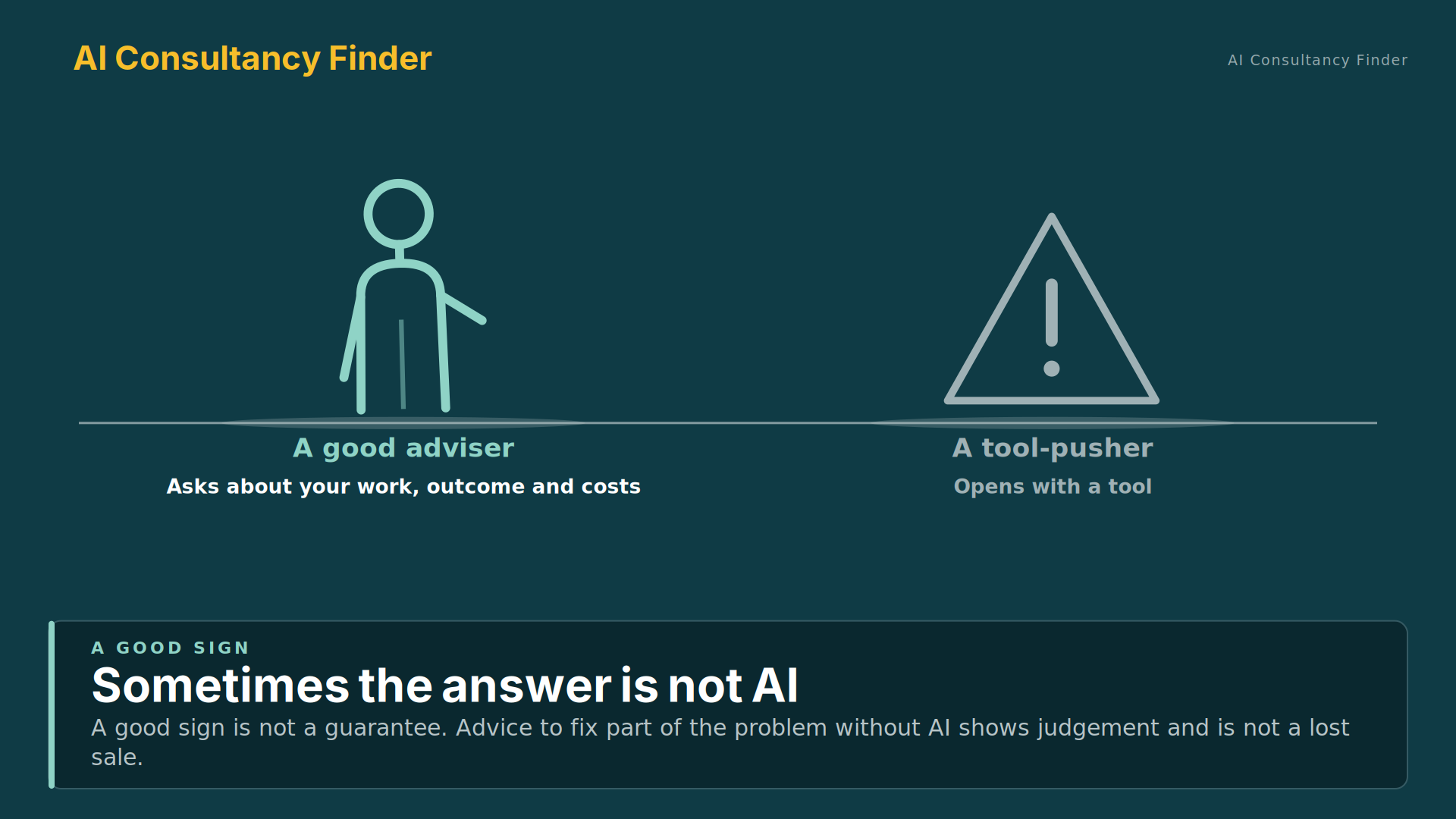
- Notice who asks the questions. A good adviser starts by asking what outcome must change and what the problem costs you, not by pitching a tool.
| A good sign | A warning sign |
|---|---|
| Asks about your workflow, your costs and who does the work | Names a tool or platform in the first ten minutes |
| Says part of your problem needs a process fix, not AI | Says AI will solve all of it |
| Puts their value in your measures: hours, cost per job | Talks only about accuracy scores and features |
| Offers a customer you can speak to | Offers only case studies they wrote themselves |
| Explains plainly how training and handover will work | Treats the build as the whole job |
For the questions to take into each first call, see questions to ask an AI consultant. For the behaviours that should worry you, see red flags when hiring an AI consultant.
The surprising part: the best first meeting may end with "not AI"
It feels odd to pay someone who tells you not to buy what they sell. But an adviser who says that part of your problem needs a process change or plain automation, rather than AI, is showing you exactly the judgement you are paying for. Treat it as a good sign, not a lost sale.
What does a sensible first project look like, and how long should it take?
Small, real and measurable. One routine task with clear inputs, done behind the scenes rather than in front of customers, using your actual data, with a hard measure and a decision date agreed at the start.
We have not found a published source for how long a typical small-business first project takes in the UK, so we will not give you a number. A useful rule is that it should end while everyone still remembers why it started: weeks, not an open-ended programme. Ask for it to be paid and time-limited. Free pilots tend to drift, and a fixed fee and end date keep both sides focused. For what different budgets buy, see how much an AI consultant costs.
Agree before you start what result means carry on, change course or stop. Our guides to a good first AI project and why AI pilots stall go into this in more detail.
What should I expect to have at the end?
- A clear answer: carry on, change course or stop, based on the measure you agreed.
- Before-and-after figures for time, errors and the time spent checking the output.
- Someone on your team who understands how it works and can adjust it.
- A list of the changes your team can now make without the consultant.
- A copy of everything that makes it work: settings, instructions, examples, your data.
- A short note of what went wrong during the project and how it was caught.
The point about changes matters most. Agree up front which adjustments your team must be able to make unaided after handover, and write it into the agreement. That protects you if you part ways, and it is the best defence against being locked in: see how to avoid AI lock-in.
What if I have already hired badly?
It happens, and it is fixable. Write the one-page problem statement now, as if starting fresh, and ask your current provider to measure against it. Ask for a copy of your data and the system's settings. If the answers are vague, you have learned what to look for next time, and the next choice will be better for it.
Common questions
Is a big firm safer than a small one?
Not in itself. Size tells you little about whether the person who will actually do the work understands your problem. Ask who that person is, speak to them before you sign, and judge them on your brief.
Should I pay for a strategy before any build?
For most small businesses, a long strategy document is less useful than one well-run first project. A short scoping piece that ends in a single, measurable project is often the better buy.
What if a consultant will not agree a measure?
Ask why. A good consultant welcomes a clear target, because it gives them a fair way to show they delivered. See how your AI consultant will measure success.
When you are ready, the rest of this series covers each step in turn, from the questions to ask to checking credentials.