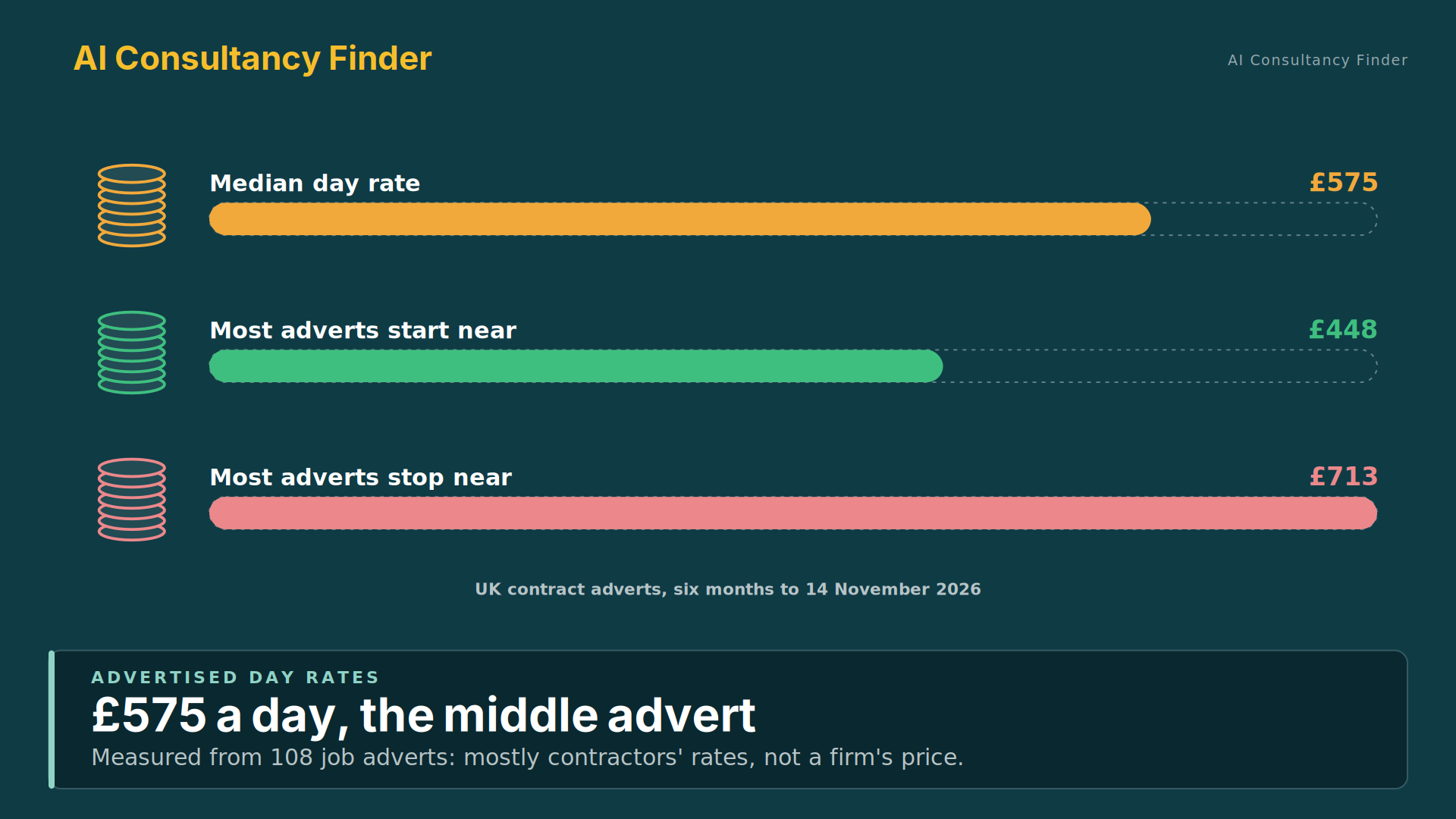
You want a number before you talk to anyone. That is sensible: without one, you cannot tell a fair quote from an expensive one. The short answer is that published UK day rates for AI consultancy work sit roughly between £450 and £700, with a median of £575.1 A typical small business spends a few thousand pounds a year on AI in total, which buys somewhere between a week and a month of a consultant's time.
Every figure below comes from a named source, with the date it was published and the date we read it. Each one measures something slightly different, so we say what it does and does not tell you. We refresh this guide every six months.
Key takeaways
- Advertised UK contract rates for AI consultants have a median of £575 a day (ITJobsWatch, 6 months to 14 November 2026).
- These are contractor rates, not consultancy prices. A firm may charge more to cover its overheads and risk.
- Businesses with 10 to 49 staff spent a mean of £10,500 on AI in 2025, and 43% of AI-using businesses spent nothing.
- No published source gives a typical project size, so treat annual spend as a rough proxy.
- The fee is often not the biggest cost. Running and checking the result can be.
What does an AI consultant charge a day in the UK?
Two sources publish UK day rates for this kind of work.
| Source | What it reports | What it measures |
|---|---|---|
| ITJobsWatch | Median £575 a day; 10th to 90th percentile £448 to £713 | Advertised contract rates for "AI Consultant" roles |
| YunoJuno | "AI & Automation" average £472 a day (2025), £459 (2024) | Rates paid through one freelance platform |
| YunoJuno | Average across all disciplines £410 a day | The same platform, every kind of work |
ITJobsWatch tracks job adverts. Over the 6 months to 14 November 2026, the median advertised contract day rate for an "AI Consultant" was £575, down from £600 in 2025 and £675 in 2024.1 Most adverts fell between £448 (10th percentile) and £713 (90th percentile). The figure comes from 108 adverts, and it is a contractor's rate, not a consultancy's price.
YunoJuno reports rates paid through its freelance platform. Its UK "AI & Automation" average day rate was £459 in 2024 and £472 in 2025. YunoJuno itself calls these "directional benchmarks", so read them as a guide, not a price list.2
The same page breaks rates down by role and seniority: "AI Consultant: £439", "AI Product Consultant: £800", "Senior: £460" and "Director: £900". It gives no year or sample size for these rows, so they show the spread rather than a reliable average.2
For comparison, YunoJuno's average across all disciplines was £410 a day.3 AI work costs a little more than the average contract.
Why do the figures from different sources differ?
Because they count different things.
- Adverts versus payments. ITJobsWatch counts rates offered in job adverts. YunoJuno counts rates on its own platform. Neither sees every deal.
- Roles versus categories. "AI Consultant" is a job title. "AI & Automation" covers a wider mix of work, including more hands-on building.
- Contractors versus firms. Both sources mostly describe individuals. A consultancy or agency also pays for sales, management, insurance and gaps between projects, so its day rate is usually higher than a contractor's. No published source tells us by how much.
So use the figures as a range to sense-check a quote, not as the "right" price.
How much do small businesses actually spend on AI?
The best source is the government's own survey. The AI adoption survey 2026, published by the Department for Business, Innovation, Science and Trade on 29 October 2026, gives mean annual AI spend in 2025 by business size (report p.43):4
| Business size | Mean AI spend in 2025 |
|---|---|
| Micro | £3,500 |
| Small (10 to 49 staff) | £10,500 |
| Medium | £11,000 |
| Large | £25,000 |
| All businesses | £7,500 |
Two things stand out. First, 43% of businesses already using AI spent nothing on it in 2025 (p.43):4 free tools and features built into existing software go a long way. Second, the mean is pulled up by a few big spenders. Reading figure 16, spend by small firms (10 to 49 staff) in 2025 was roughly:4
- £0: 43%
- £1 to £1,000: 19%
- £1,000 to £9,999: 25%
- £10,000 to £25,000: 6%
- over £25,000: 6%
These are read from a chart, so treat them as approximate. In other words, most small firms that use AI spend under £10,000 a year on it.
The survey also shows how many businesses use AI at all: 27% of micro, 34% of small, 47% of medium and 52% of large businesses (p.21).4
The caveat that matters: The survey is a telephone survey of 3,503 businesses with 5 or more employees, run from 7 January to 21 April 2026.4 It covers businesses with 5 or more staff only, so it says nothing about sole traders or firms of 1 to 4 people. It also counts all AI spend, including software, not just consultancy.
How many consultant days does a typical budget buy?
This is our arithmetic on two of the figures above, not a published figure. At the £575 median day rate, a £3,500 annual budget (the micro-business mean) buys about 6 days (£3,500 ÷ £575 = 6.1). A £10,500 budget (the small-business mean) buys about 18 days (£10,500 ÷ £575 = 18.3).
So a typical small-business AI budget buys somewhere between one and four working weeks of a contractor at the median rate, before any software or running costs. If a consultancy charges more than the median, the same budget buys fewer days.
Is there a typical project size?
No citable source exists for the typical size of a small-business AI consultancy project. We looked. Some firms publish their own prices, but those are offers, not market figures, and one firm's price does not tell you what things cost.
Annual AI spend from the government survey is the closest proxy, and it is only a proxy: it includes software and subscriptions as well as outside help. When you set a budget band in your project brief, choose one you could afford to learn from, and ask consultants to suggest options at different sizes.
What drives the price up or down?
The day rate is only part of the story. These are the things that change what you will actually pay.
- Scope. Advice and a plan cost less than building and connecting systems. A short, paid first project on one task keeps the bill small and tells you a lot. See what a good first AI project looks like.
- The state of your data. Cleaning up and connecting information is often where the hours go. See getting your data ready for AI.
- The size of the AI model. Proposing the most powerful model for every job inflates running costs. Ask the consultant to justify the choice, and to price a simpler option alongside it.
- Running costs that grow with use. Many tools charge by use. Ask for the cost per task at your expected volume and in a busy month. Model prices can rise too, so check the numbers still work if they do.
- Checking time. Your staff will spend time reviewing what the AI produces. Any saving should be counted after that time, not before.
- Training and adoption. A tool nobody uses is money wasted. Budget for helping your team learn it, not only for the build.
- Pricing structure. Pay-as-you-grow pricing and a basic tier you can upgrade let you start small. Large up-front commitments do the opposite.
Is the consultant's fee the biggest cost?
Often not. Over the life of a project, the ongoing costs can be larger than the fee: software and usage charges, monitoring, updates, and the time your own staff spend checking outputs. Ask every consultant to set these out in their quote, so you can compare the full cost, not just the headline. Our guide to telling whether AI is paying off shows how to count them once the tool is running.
- Compare each quote's day rate with the published range above.
- Ask what is and is not included in the price.
- Ask for monthly running costs at normal and busy volumes.
- Ask whether forecast savings count your staff's checking time.
- Ask what a smaller first project would cost.
- Ask who owns what is built, and what leaving would cost.
What if I have already agreed a price that looks high?
Do not panic. A higher price can be fair if it covers more: a team, testing on your data, training and support. Ask the consultant to break the price down and to say what you will have at the end. If the first stage has not started, ask whether it can be split into a smaller first step with a decision point. For the warning signs worth watching, see red flags when hiring an AI consultant.
When you are ready to compare quotes, start with how to choose an AI consultant and questions to ask an AI consultant.
Sources
-
ITJobsWatch, "Artificial Intelligence Consultant contracts: UK" (rolling six months to 14 November 2026), https://www.itjobswatch.co.uk/contracts/uk/artificial%20intelligence%20consultant.do, accessed 2026-11-14. Advertised contract rates from 108 adverts. ↩ ↩2
-
YunoJuno, "AI and automation contractor rates", 2026 Contractor Rates Report (undated page), https://www.yunojuno.com/freelancer-rates-report/ai-automation-contractor-rates, accessed 2026-11-14. ↩ ↩2
-
YunoJuno, "YunoJuno releases 2026 Contractor Rates Report" (press release), 3 June 2026, https://www.yunojuno.com/press-release/yunojuno-releases-2026-contractor-rates-report-ai-product-and-technology-skills-continue-to-drive-contractor-market-growth, accessed 2026-11-14. ↩
-
Department for Business, Innovation, Science and Trade, "AI adoption survey 2026", 29 October 2026, https://www.gov.uk/government/publications/ai-adoption-survey-2026, accessed 2026-11-14. Telephone survey of 3,503 UK businesses with 5 or more employees, 7 January to 21 April 2026. ↩ ↩2 ↩3 ↩4 ↩5