If you work in an organisation of 250 people or more, or in a public body, AI is probably already in use somewhere, whether or not anyone signed it off. Your questions are about scale and control: how to buy through the right routes, how to check suppliers properly and how to give your board real oversight. This guide covers those, and links to the detailed guides on each.
In this guide a large organisation has 250 or more employees, the band the government uses. At the start of 2025 there were 8,335 private sector businesses of this size in the UK, about 0.15% of all businesses, but they employed about 11.2 million people, around 40% of private sector employment.1 Those figures do not include public bodies, which this guide also covers.
Key takeaways
- Over half of large businesses were using AI in 2026. The task now is to bring scattered use under control and scale what works.
- Public bodies can buy through frameworks such as G-Cloud. Check the current framework and its scope first.
- Ask every AI supplier the same security questions in writing, and keep the answers.
- Boards need regular, plain reporting on AI and may benefit from a director with AI experience.
What is realistic
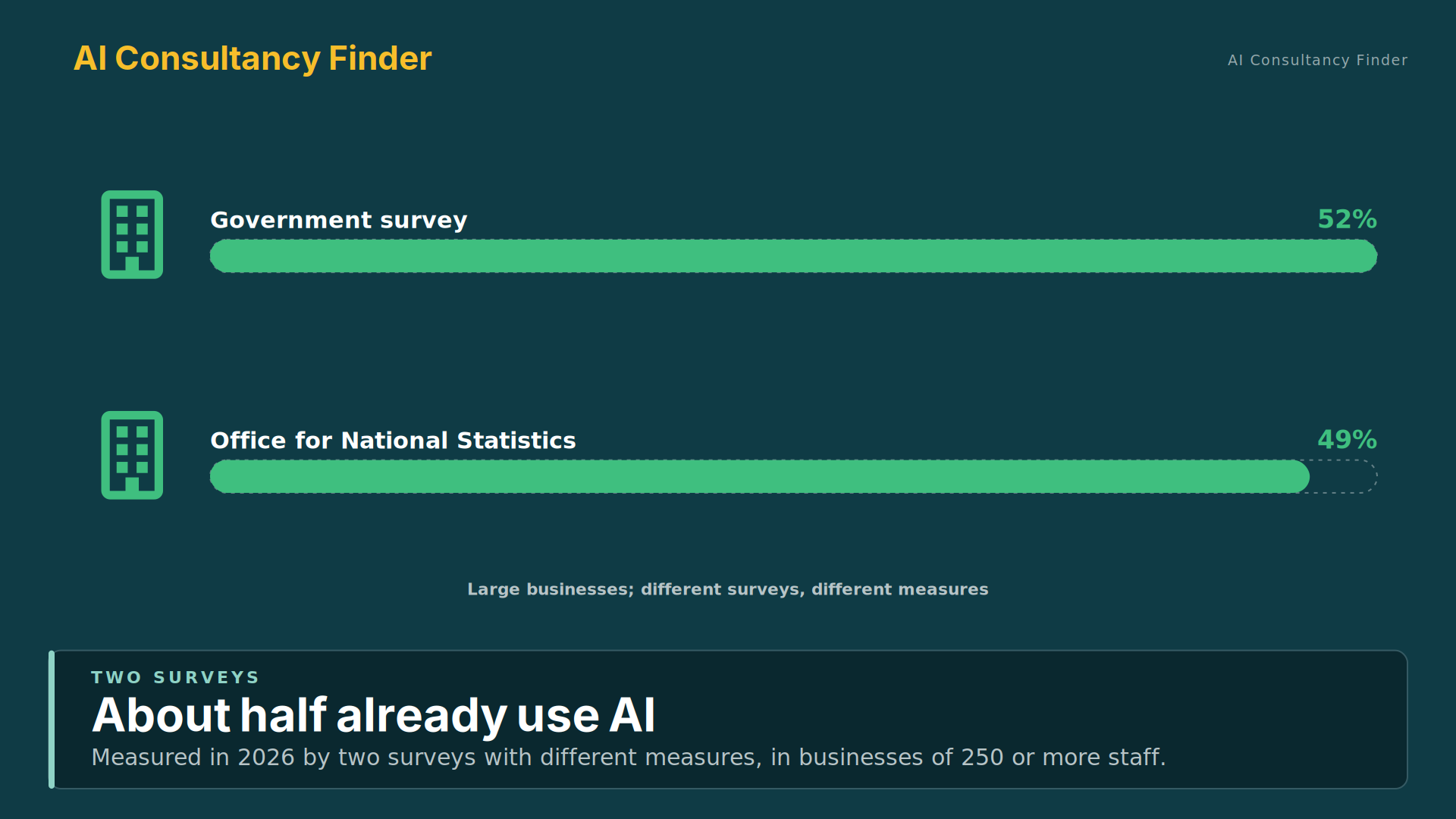
The government's AI adoption research found 52% of businesses with 250 or more employees were using AI in 2026.2 The Office for National Statistics found 49% of businesses with 250 or more employees reported using at least one AI technology in June 2026, using a different survey and measure.3 Either way, the starting point is not zero.
At this size the realistic gains come from processes that run across many teams or sites: customer service, case handling, document review, forecasting and internal knowledge search. The common failure is a long list of pilots, each owned by a different department, none reaching daily use. A small central team that sets standards and shares what works usually does better than a free-for-all or a block on everything.
Typical first projects
- Bringing existing use under control: find out which AI tools staff already use, and move the useful ones to approved, company-managed accounts.
- Knowledge and case work: helping staff find answers in large bodies of policy, guidance and past cases.
- Customer and citizen contact: drafting replies and summarising cases, with a person checking before anything goes out.
- Document-heavy processes: tenders, contracts, reports and correspondence.
How to buy: frameworks and procurement routes
Large private companies usually have their own procurement process. Public bodies normally buy through public procurement rules and approved routes, and should follow their own procurement team's advice.
One common route for cloud services is G-Cloud, a framework agreement run by the Government Commercial Agency, which was called the Crown Commercial Service until 1 April 2026.4 The current version, G-Cloud 15, started on 6 August 2026.5 It covers cloud hosting, software and cloud support services, and is open to buyers including central government, local authorities, health, education, charities and blue light services.5 The framework page does not mention AI specifically, so check with the supplier which service, and which category, an AI offer is listed under. The framework page is the place to check current dates and terms.
Frameworks make buying faster, but they do not do the evaluation for you. You still need a clear brief, consistent questions and a scoring method. Any of a solo consultant, an agency or a larger firm can be right at this size. A solo specialist often suits independent advice, assurance or a second opinion on a big supplier's plan. An agency suits a defined build. A larger firm suits programmes across many systems, sites or countries. Our guide to consultants, agencies and freelancers explains the trade-offs.
Security due diligence
At this size, AI suppliers should expect detailed security questions, and you should expect written answers. Ask which AI models and services the product uses, where your data goes, who can access it, how actions are logged and how the system resists prompt injection. Our guides to AI supplier security questions and prompt injection set out what to ask and why. Your own security team should own the final decision, and anything involving personal information should go past your legal and information governance advisers.
Board oversight and the AI NED
Boards do not need to understand how AI models work. They do need to know where AI is used, what value it delivers, what has gone wrong and who is accountable. A regular, short report covering those points is a good start. Directors have legal duties; take professional advice on how they apply to decisions about AI. Our guide to board oversight of AI suggests questions a board can ask.
Some boards add an AI non-executive director, a part-time board member with AI experience who can test management's plans. Others use a fractional AI leader below board level; see our guide to the fractional chief AI officer.
What it costs
No published source gives a typical price for AI projects at this size, and costs vary widely with scope. Among businesses using AI, the government research found mean total AI spend in 2025 of £25,000 for large businesses.2 That covers all AI spending, including software, and a mean across many organisations, so treat it as context, not a budget. Our cost guide explains day rates.
Free and public support
Most government support for AI adoption is aimed at smaller businesses, but some is open to larger organisations. Free AI courses through the government's AI Skills Hub are open to UK adults, so your staff can use them.6 Some Innovate UK competitions accept larger organisations; our guide to AI grants and funding explains how to check. If you work with small suppliers, our guide to UK government support for AI in small businesses shows what help they can get.
Where to go next
Our AI buyer's guidebook covers a full buying process. If your organisation is closer to 250 staff than to thousands, our guide to AI for medium-sized businesses may fit better. When you are ready to look for help, read how to choose an AI consultant or browse the directory.
Sources
-
Department for Business and Trade, "Business population estimates for the UK and regions 2025: statistical release", published 2 October 2025, https://www.gov.uk/government/statistics/business-population-estimates-2025/business-population-estimates-for-the-uk-and-regions-2025-statistical-release, accessed 2026-11-14. ↩
-
Department for Business, Innovation, Science and Trade, "Artificial intelligence adoption research 2026" (AI adoption survey 2026), published 29 October 2026, pages 21 and 43, https://www.gov.uk/government/publications/ai-adoption-survey-2026, accessed 2026-11-14. ↩ ↩2
-
Office for National Statistics, "Artificial intelligence in UK businesses: 2023 to 2026", published 20 July 2026, https://www.ons.gov.uk/businessindustryandtrade/business/businessservices/articles/artificialintelligenceinukbusinesses/2023to2026, accessed 2026-11-14. ↩
-
Government Commercial Agency, "Government Commercial Agency privacy notice", change note of 1 April 2026: "On 1 April 2026, Crown Commercial Service became Government Commercial Agency", https://www.gov.uk/government/publications/government-commercial-agency-privacy-notice, accessed 2026-11-14. ↩
-
Government Commercial Agency, "G-Cloud 15 (RM1557.15)", undated, https://www.gca.gov.uk/agreements/RM1557.15, accessed 2026-11-14. ↩ ↩2
-
GOV.UK, "Free AI training for all, as government and industry programme expands to provide 10 million workers with key AI skills by 2030", published 28 January 2026, https://www.gov.uk/government/news/free-ai-training-for-all-as-government-and-industry-programme-expands-to-provide-10-million-workers-with-key-ai-skills-by-2030, accessed 2026-11-14. ↩