If you work alone or run a business with fewer than 10 people, you are probably wondering whether AI is worth your time at all, and whether any of the advice out there was written for someone like you. It was not, mostly. This guide is.
In this guide a micro business means a business with 0 to 9 employees, which includes sole traders and partners who work on their own. That is our band, chosen to match how most people think about size. The government's business population figures count businesses with no employees and those with 1 to 9 employees separately.1 At the start of 2025 there were 4,272,535 private sector businesses with no employees and 1,150,875 with 1 to 9, out of 5,690,265 in total.1 Together that is about 95% of UK businesses (our arithmetic on the published counts).
You may also have heard "micro-entity" from your accountant. That is an accounting category at Companies House, with its own test based on turnover, balance sheet and staff numbers.2 It is a different test from the employee bands in this guide, so a business can be micro in one sense and not the other.
Key takeaways
- Start with one dull, repeated task you do every week, and try a general AI assistant on it before you pay anyone.
- Most of the value at this size comes from tools you already pay for or can try free, not from a custom build.
- If you do buy help, a short, fixed-scope piece of work is usually a better fit than an open-ended engagement.
- Free training and business support exist, and are worth an hour before you spend money.
What is realistic at this size
The honest answer is that you will mostly use AI built into tools, rather than build anything. The government's AI adoption research for 2026 found that among businesses using AI, 43% spent nothing on it in 2025, which the report puts down to AI built into existing software and free or low-cost tools.3
That suits a micro business. You do not have a data team or an IT department, and you are the person who will set it up. The realistic goals are saving a few hours a week, answering customers faster and making fewer small mistakes.
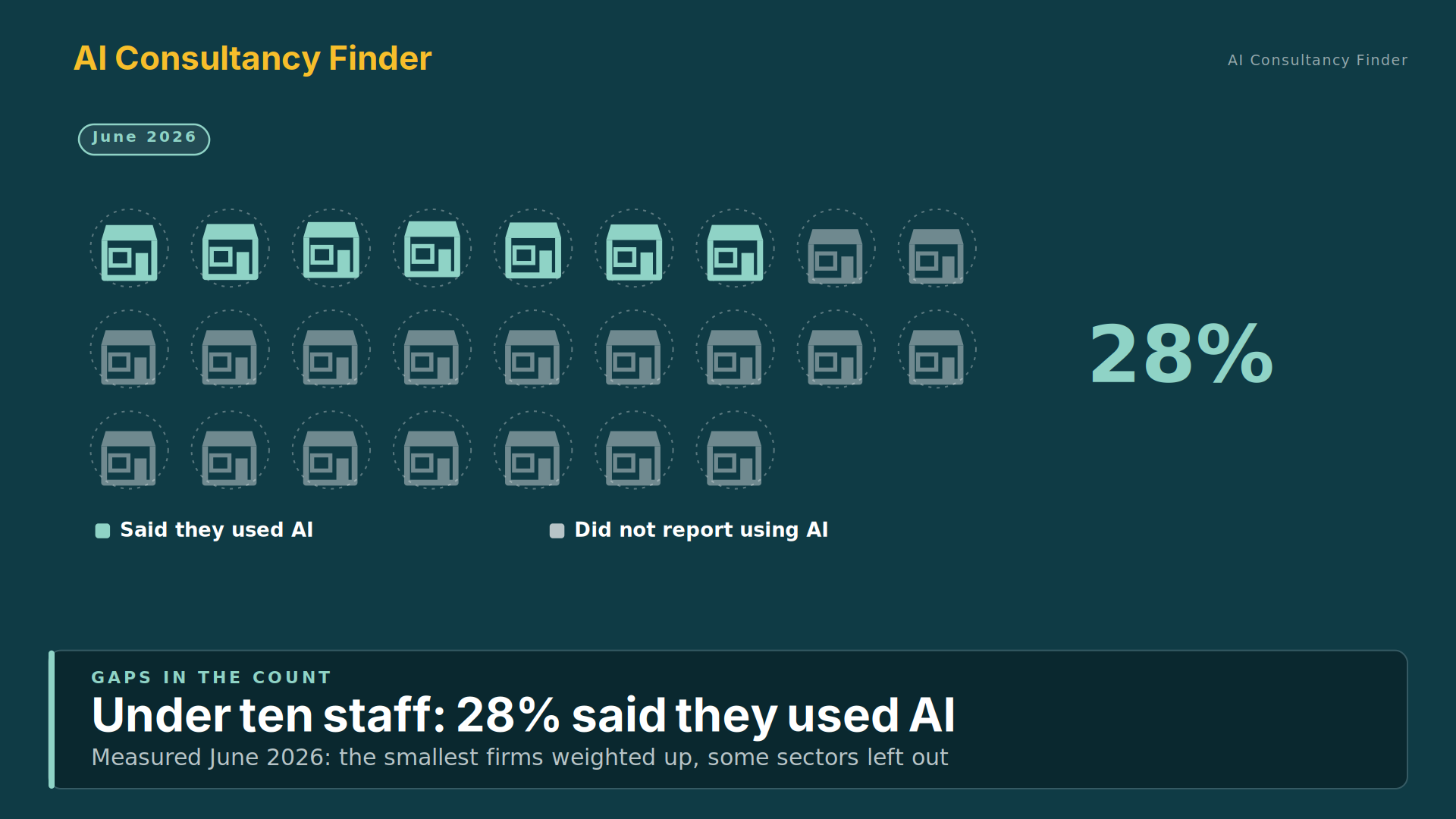
There is one gap in the evidence to know about. That survey covered businesses with 5 or more employees, so it says nothing about sole traders or firms of 1 to 4 people.3 It found 27% of businesses with 5 to 9 employees used AI.3 A separate Office for National Statistics survey found 28% of businesses with 0 to 9 employees reported using at least one AI technology in June 2026, though the ONS notes its smallest firms carry large survey weights and some sectors are excluded.4 No published source gives a reliable figure for sole traders on their own.
Typical first projects
Good first projects share three features: you do them often, the result is easy to check, and a mistake is cheap to fix. Some examples:
- Drafting: quotes, proposals, routine emails and social media posts from your own notes.
- Answering the same questions: a set of standard replies for enquiries you get every week.
- Admin: summarising meeting notes, tidying a spreadsheet of contacts, or turning a voice note into a to-do list.
- Simple automation: moving details from a web form into your diary or accounts software without retyping them.
A plumber who spends Sunday evenings writing up quotes, or a bookkeeper answering the same five client questions, is a good example of where to start. Pick one task, time it for a fortnight, then try it with AI and time it again. If you cannot tell whether it helped, it probably did not help enough.
How to buy help
Many micro businesses never need outside help, and that is fine. You might want it when you have tried the obvious tools and hit a limit, or when an automation needs connecting systems you do not understand.
At this size the realistic choices are a solo consultant or freelancer, or a small agency. A solo consultant suits a short piece of advice or a small setup where you want to deal with one person. A small agency can suit a build that needs more than one skill, but check who will actually do the work. A larger firm is rarely a fit for a first project at this size, mainly because its minimum engagement is often bigger than your whole budget. None of these is better in general. Our guide to consultants, agencies and freelancers explains when each fits.
Whoever you choose, ask for a fixed price for a defined piece of work, a plain explanation of what you will own at the end, and what happens if the tool they set up changes or stops. A one-page project brief helps more than you might expect, even for a small job.
What it costs
No published source gives a typical project size or price for micro businesses. The closest guide is what businesses report spending on AI overall. Among businesses using AI, the government research found mean spend in 2025 rose with size, from £3,500 for businesses with 5 to 9 employees.3 That is an average across all AI spending, including software, and it excludes firms with fewer than 5 staff, so treat it as a rough pointer, not a quote.
Our cost guide sets out sourced day rates and what a small budget buys.
Governance without the paperwork
You do not need a policy document. You do need a few habits:
- Keep a short list of which AI tools you use and what you put into them.
- Check anything AI writes before it goes to a customer.
- Turn on two-step login for every AI tool account.
- Know how you would stop using a tool and get your data out.
Our guide to AI security for small businesses covers the basics in plain terms.
Free support
Before you spend money, use what is free. Government-backed free AI courses, some under 20 minutes, are available to UK adults through the AI Skills Hub.5 Our guides to free AI training and UK government support for AI in small businesses list what is available and who can use it.
Some programmes have a minimum size. Help to Grow: Management, for example, is open to businesses with between 5 and 249 employees, at least five of them permanent staff on the payroll, so a sole trader cannot join.6 Check the current terms of any programme before you apply.
Where to go next
If you are still deciding whether AI is relevant, start with our plain-English guide to AI for small business. If you have grown past 10 staff, our guide to AI for small businesses with 10 to 49 staff picks up from here. When you are ready to look for help, read how to choose an AI consultant or browse the directory.
Sources
-
Department for Business and Trade, "Business population estimates for the UK and regions 2025: statistical release", published 2 October 2025, https://www.gov.uk/government/statistics/business-population-estimates-2025/business-population-estimates-for-the-uk-and-regions-2025-statistical-release, accessed 2026-11-14. ↩ ↩2
-
Companies House on GOV.UK, "Accounts for micro-entities, small and dormant companies", undated, https://www.gov.uk/annual-accounts/microentities-small-and-dormant-companies, accessed 2026-11-14. ↩
-
Department for Business, Innovation, Science and Trade, "Artificial intelligence adoption research 2026" (AI adoption survey 2026), published 29 October 2026, pages 21 and 43, https://www.gov.uk/government/publications/ai-adoption-survey-2026, accessed 2026-11-14. ↩ ↩2 ↩3 ↩4
-
Office for National Statistics, "Artificial intelligence in UK businesses: 2023 to 2026", published 20 July 2026, https://www.ons.gov.uk/businessindustryandtrade/business/businessservices/articles/artificialintelligenceinukbusinesses/2023to2026, accessed 2026-11-14. ↩
-
GOV.UK, "Free AI training for all, as government and industry programme expands to provide 10 million workers with key AI skills by 2030", published 28 January 2026, https://www.gov.uk/government/news/free-ai-training-for-all-as-government-and-industry-programme-expands-to-provide-10-million-workers-with-key-ai-skills-by-2030, accessed 2026-11-14. ↩
-
Small Business Charter, "Help to Grow: Management course FAQs", undated, https://smallbusinesscharter.org/help-to-grow-management/course/faqs, accessed 2026-11-14. ↩