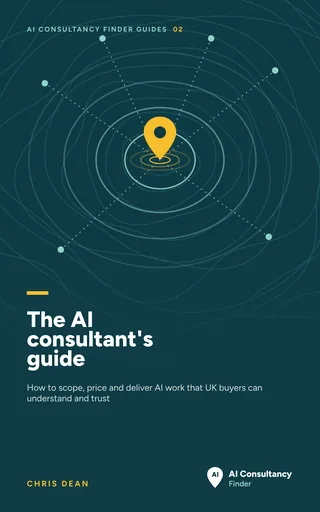
If you sell AI help to businesses, you will keep meeting the same questions: how to scope work you do not fully understand yet, how to price it fairly, and how to show results that buyers will believe. Our AI consultant's guidebook sets out how to answer them, in one book you can keep beside you, coming soon to Amazon in paperback, Kindle and audio.
Key takeaways
- One book for freelancers, consultancies, agencies and specialist teams.
- Covers scoping, pricing approaches, proposals, ethics, evidence and the directory's independence rules.
- Describes pricing approaches and their trade-offs; it quotes no market rates, because no published source gives them.
- Written from the buyer's side: it prepares you for the questions informed buyers now ask.
What's inside
- Understand the buyer. What owners and managers worry about, and what changes from a micro business to a large organisation.
- Scope the work. Tie it to one problem and one measure, offer a paid discovery when the problem is unclear, and write down what is not included.
- Price the work. Day rate, fixed price, phased pricing, retainers and value-based pricing: who carries the risk in each, and when each fits.
- Write a proposal a buyer can understand. A ten-part structure, plain language and answers to the questions buyers ask before they ask them.
- Be honest about what AI can and cannot do. Mistakes, uncertain results, security risks your design cannot remove and the limits of your own skills.
- Handle conflicts and know when to say no. Declaring commissions and partnerships, recommending against your own interest, and referring work on.
- Evidence your results honestly. Baselines, whole results, no inflated case studies, and written consent before you name a client or a reference.
- Work within the directory's independence rules. Directory order and badges are never for sale, buyer guidance is editorially independent, paid content is labelled and buyer data is never sold. The guidebook explains what each means for how you present your practice.
- Look after your own position. Contracts, insurance, records, and checking your working status with HMRC's CEST tool and a qualified adviser.
A checklist at the end pulls the main points together.
Who it's for
It is for anyone offering AI advice, building or training to UK businesses, whether you work alone or in a team. Most buyers on this site run micro, small or medium-sized businesses, so much of the guidance is about working with owners who have no technical staff. The same principles apply to larger clients, with more formal buying.
Why we wrote it
Buyers who read our guides arrive asking about baselines, ownership, handover, running costs and security. The guidebook is, in effect, the other half of that conversation. Reading what buyers read is good preparation: start with questions to ask an AI consultant, red flags when hiring an AI consultant and how to check an AI consultant's credentials. There is a buyer's version too: the AI buyer's guidebook.
If you offer part-time leadership roles, see also offering fractional AI leadership.
What it is not
The guidebook is general guidance, dated 14 November 2026. It is not professional advice on law, tax or finance, and it gives no view on how any tax or status rules apply to you.