You have heard that AI could help your business grow, but you are not sure where to start or how you would know it worked. This page explains how to use AI for business growth in a way you can measure, and points to our book with a full 90-day plan and checklists, coming soon to Amazon.
Key takeaways
- Decide first whether you need more revenue, lower costs or more capacity.
- Test one or two specific tasks, not "AI" in general.
- Measure the task before you change it, or you cannot tell if it worked.
- Count every cost, including the time people spend checking AI output.
Start with what you want to change
AI can help a business grow in three ways. It can bring in more revenue, for example by answering enquiries faster or following up quotes. It can lower costs, for example by cutting admin hours or rework. Or it can add capacity, so the people you have can take on more work without you hiring.
Most owners have one of these that matters most. If you are turning work away, it is capacity. If you could handle twice the enquiries, it is revenue. Knowing which one you want stops you buying a tool that solves a problem you do not have.
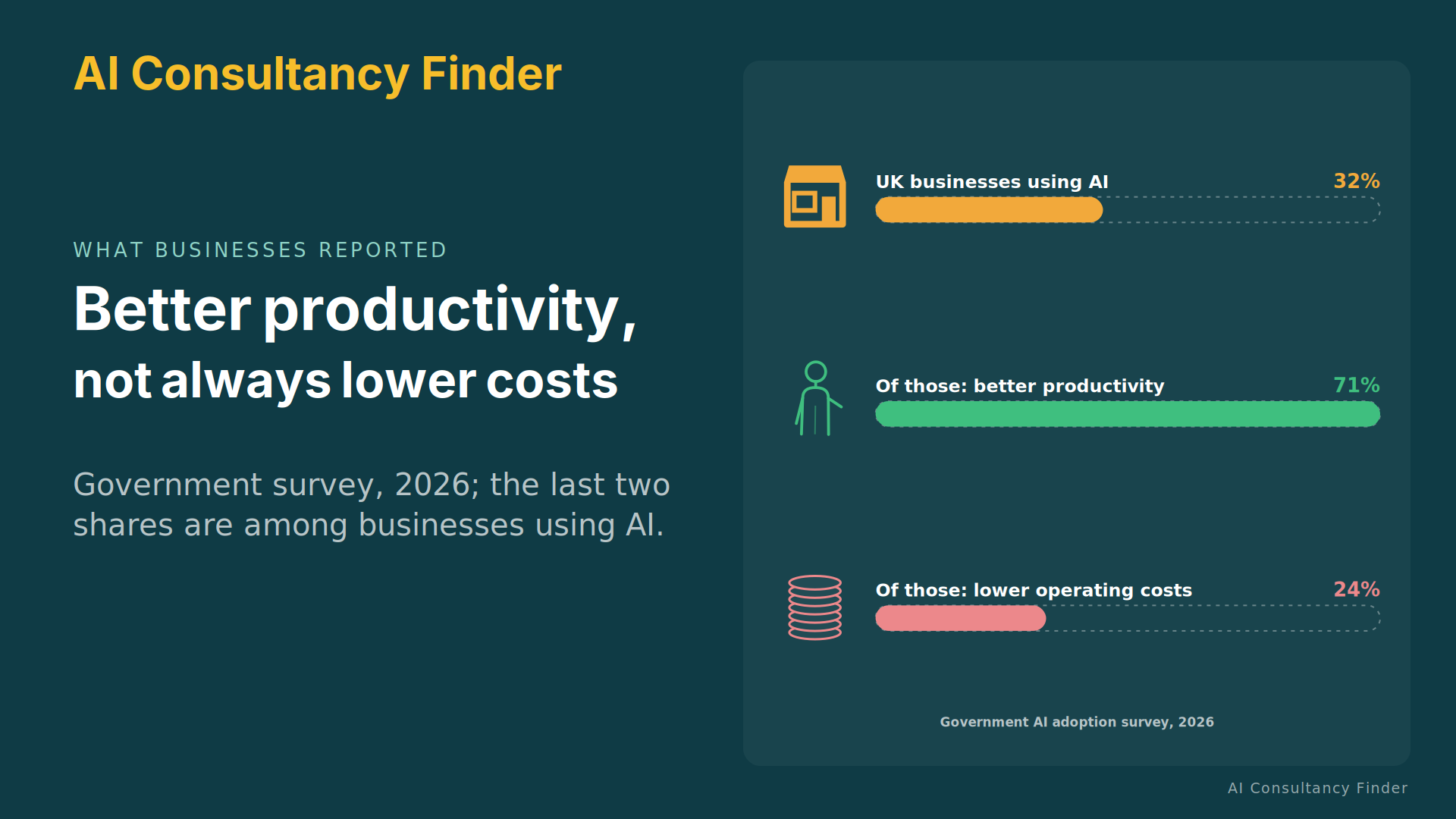
It also helps to keep expectations realistic. The government's AI adoption survey for 2026 found that 32% of UK businesses used at least one AI technology.1 Of those, 71% named improved workforce productivity among the impacts AI had had on their business, yet only half (50%) reported an increase in their employees' overall productivity.2 Only 24% saw lower operating costs and 64% saw no immediate financial effect.1 Saved time only turns into growth if you decide in advance what it is for.
Pick one or two growth levers
A growth lever is one task where a change would move revenue, cost or capacity in a way you can count. "Use AI in marketing" is too vague. "Reply to every website enquiry within an hour" is a lever.
Good first levers happen often, follow a pattern, are linked to money and can be measured today. Most important, a person should be able to catch a mistake before it reaches a customer. Leave anything touching contracts, pay or legal positions until you have more experience and proper advice.
A micro business usually needs one lever. A small or medium-sized business can run two, as long as each has a named owner with time to look after it.
Run a 90-day test
Ninety days is long enough to see a result and short enough to keep attention. Our guide splits it into three stages:
- Weeks 1 to 2: decide and measure. Describe the task, pick one measure, record a baseline for at least a week, set a budget and agree simple rules for AI use.
- Weeks 3 to 6: try it small. Start with the simplest option, often a tool you already pay for. Run the new way alongside the old one on real work, with a person checking everything.
- Weeks 7 to 12: run it and decide. Measure the same way as the baseline, count all the costs and decide to continue, change or stop.
Stopping is a fine result.
Measure payback honestly
Payback is how long it takes for what you gain to cover what you spent. Include subscriptions, setup, training time and the minutes spent checking each output. Do not count hours saved as money saved unless the time goes into paid work or you actually spend less. The guide includes a worked example with the arithmetic shown.
Bring your team and get the basics right
Tell people what you are testing before you buy anything, and find the person who is already curious about AI. Skills are the most common barrier: 67% of businesses already using AI reported limited skills or knowledge.1 Free courses can help; see our guide to free AI training in the UK.
If you are unsure where to begin at your size, read our guides for micro businesses, small businesses and medium-sized businesses. For wider help, see our overview of UK government support for AI in small businesses. Before you connect any tool to your email or files, read AI security for small businesses. For anything involving cashflow or borrowing, talk to your accountant.
Get the full guide
The guide covers each of the usual management areas (strategy, operations, marketing and sales, people, productivity, finance and digital basics) with ideas for each, the full 90-day plan and printable checklists.
If you decide you need outside help, finish weeks 1 and 2 yourself first, then use the AI buyer's guidebook to write a brief and compare offers.
Sources
-
Department for Business, Innovation, Science and Trade, "AI adoption survey report 2026: executive summary", published 29 October 2026, https://www.gov.uk/government/publications/ai-adoption-survey-2026/ai-adoption-survey-report-2026-executive-summary, accessed 2026-11-14. ↩ ↩2 ↩3
-
Department for Business, Innovation, Science and Trade, "Artificial intelligence adoption research report 2026", chapter "Impact of AI", Figure 19 (question D1, impacts of using AI) and Figure 21 (question D5, change in employees' overall productivity), base: businesses using AI, unweighted base 1,224, published 29 October 2026, https://assets.publishing.service.gov.uk/media/6ae202189bca21f1c5036e99/artificial-intelligence-adoption-research-report-2026.pdf, accessed 2026-11-14. ↩